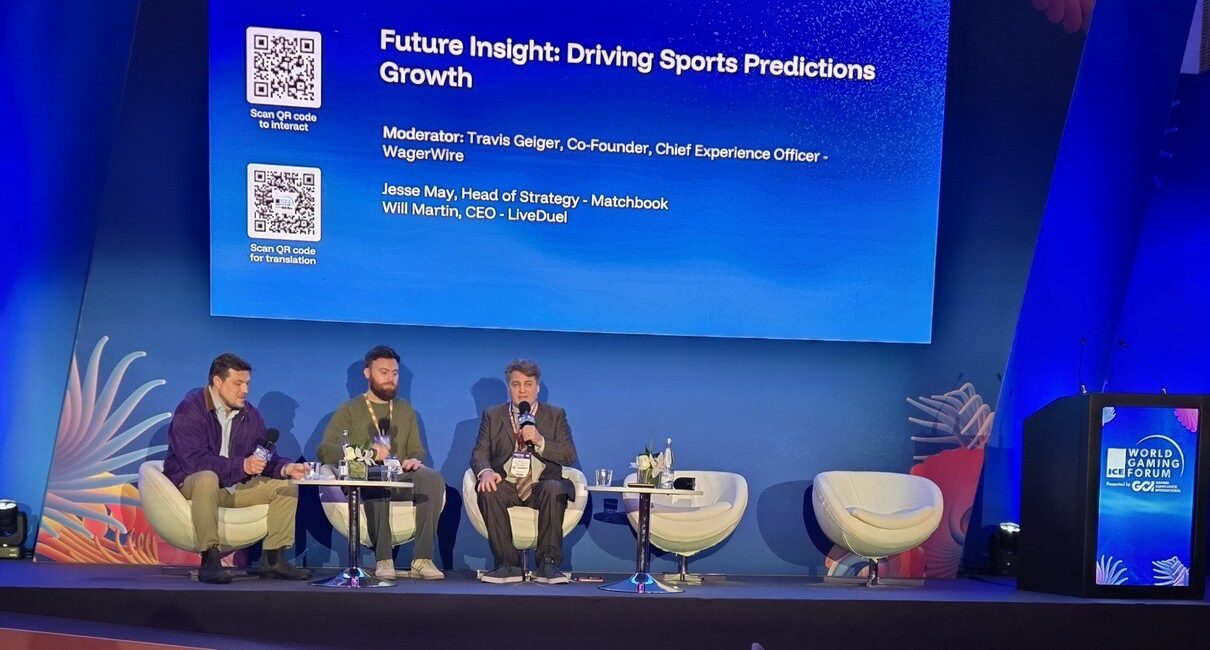
Stakeholders at the ICE conference took differing views on global expansion of prediction markets.
As kickoff nears for Super Bowl LX on Sunday, there are clear signs that trading volume on prediction markets has dramatically risen from the run-up to last year’s big game.
Through Tuesday afternoon, volume on Super Bowl event contracts at Kalshi eclipsed $161.4 million, representing a considerable uptick from the site’s Super Bowl debut in 2025. This year, the intensity of action on the field between the New England Patriots and Seattle Seahawks may be matched by the level of debate about prediction markets, whose wagering options have emerged as a viable competitor for traditional sportsbooks.
When the Philadelphia Eagles shattered the Kansas City Chiefs’ hopes for a championship three-peat last year, Kalshi saw trading volume of $27 million on an event contract that gave users a binary option for predicting the winner. It was the first time Kalshi had offered Super Bowl contracts, shortly after the site expanded into NFL derivatives. This year, activity already dwarfs last year’s total by a considerable margin.
At last month’s ICE Conference in Barcelona, stakeholders sat on multiple panels addressing the commercial and regulatory implications for the new asset class. That was before the NFL this week announced eight games will be played outside the US during the 2026-27 regular season, with the majority located in Europe. The league’s expansion of its international menu could present an opportunity for prediction market growth in Europe, where operators have encountered a number of hurdles on the regulatory front.
The battle lines have been drawn
A number of prominent US gaming executives spoke in Barcelona at the ICE conference. An American Gaming Association executive joined several tribal gaming officials on a panel that addressed the legal defence that states and tribal nations have forged against prediction markets. The AGA stressed its alliance with the Indian Gaming Association in trying to prevent what they deem to be unregulated, illegal sports betting.
“The legal, commercial and tribal gaming industry will fight this battle until the end to prevent another attempt to trample on states’ rights, tribal sovereignty and consumer protections,” Tres York, the AGA’s vice president of government relations, told iGB.
In recent weeks, sportsbook giants DraftKings and FanDuel have left the AGA while launching prediction market offerings. Prediction market advocates contend that sports event contracts are not subject to state regulation and fall under the purview of the federal government through the US Commodity Futures Trading Commission.
The gamification of finance
Exchange wagering entrepreneurs took part in a separate ICE panel titled “Future Insight: Driving Sports Predictions Growth”. Beyond DraftKings, financial exchanges such as CME Group, Robinhood and Crypto.com have launched prediction markets over the last year. Another major player in the finance space, Cboe Global Markets, has been rumoured to be entertaining a move into prediction markets with contracts that contain option-style payouts, according to the Wall Street Journal.
The explosion in interest prompted WagerWire co-founder Travis Geiger to remark that the industry is in the midst of the “financialisation of sports betting”. To buttress his point, Geiger noted that leading prediction markets have excelled at attracting outside financing, with Polymarket looking to raise funds at a valuation between $12 billion and $15 billion.
Will Martin, founder of Ireland-based LiveDuel.com, said that the convergence of finance and sports wagering across the industry can just as easily be called the “gamification of finance”.
Jesse May, head of strategy for Matchbook, opined on the panel that more sportsbook operators should be eager to add a prediction market offering once they understand that it actually will “complement, rather than cannibalise” their sports betting product.
May believes that the proliferation of prediction markets will result in “deeper liquidity pools” for every market, along with more consistent pricing. Most sportsbooks are “quite insular”, he said, suggesting it results in a dynamic that could cause trading platforms to struggle with limited participant volume.
Prediction markets, according to May, offer a bit of “democratisation” in allowing more participants than traditional books. Geiger, meanwhile, told the audience that users of prediction markets aren’t constrained by low limits that are established by regulated sportsbooks.
European expansion
Several European Union members currently ban prediction markets. Last month, Portugal’s gambling regulator ordered Polymarket to shut down amid a spike in trading on the nation’s presidential election. In Hungary, the Supervisory Authority for Regulated Activities banned Polymarket while citing unlicensed gambling operations. Still, prediction market operations are permissible in several major EU nations, most notably Spain and Germany.
While every country is going to regulate gambling in different ways, the AGA’s York stressed that numerous countries have determined that prediction markets violate their laws and have banned them. Conversely, Martin would like agencies worldwide to “match” the regulatory framework that the CFTC has adopted. Since the conference ended, CFTC Chair Michael Selig outlined plans to establish clear guidelines on prediction markets, including the withdrawal of a proposed CFTC rule that had been intended to prohibit sports-related event contracts.
The Super Bowl could be a litmus test for trading volume in California, where sports betting is illegal. In the Golden State, Indian Gaming Association Chair Victor Rocha has vowed to defeat prediction markets, whose product he argues violates tribal and state sovereignty.
According to wagering-tracking app Juice Reel, California ranks among the highest jurisdictions for prediction market adoption. Citizens analyst Jordan Bender estimates that roughly 5% of handle on the regulated sports betting market has been diverted to prediction markets, an amount that could translate to nearly $100 million from the Super Bowl.

Matt Rybaltowski
Matt is primarily responsible for long-form feature coverage on complex sports betting scandals. He also provides coverage on finance, M&A and other technological developments.
More Information & Source
Original Source:
Visit Original Website
Read Full News:
Click Here to Read More
Have questions or feedback?
Contact Us

Betsson upbeat on crypto casino amid Yolo brand acquisition report