Through a series of personal reflections from professionals across igaming and related sectors, Uplatform showcases how women are confronting long-standing stereotypes in the workplace. The initiative, released during International Women’s Month, features voices from leadership, sales, marketing, and project management roles.
Opinion.- Stereotypes. They’re sneaky, persistent, and somehow always dare to show up at work. “Women are weak.” “Women want only family.” “Women belong in support roles.” Heard them before? Yeah, so have we. But here’s the thing: these clichés are getting a serious makeover.
This International Women’s Month, we’re not just celebrating women—we’re celebrating the way they shatter assumptions, rewrite the rules, and quietly prove that the only limits are the ones they choose. In industries like igaming, fintech, and SAS, these women face labels, expectations, and a double-take or two, but they respond with skill, resilience, and results that speak louder than any stereotype ever could.
We at Uplatform asked them to share their stories. The answers? Honest, inspiring, and unapologetically themselves. Because when it comes to breaking the mould, no one does it better than women who simply refuse to fit into it.
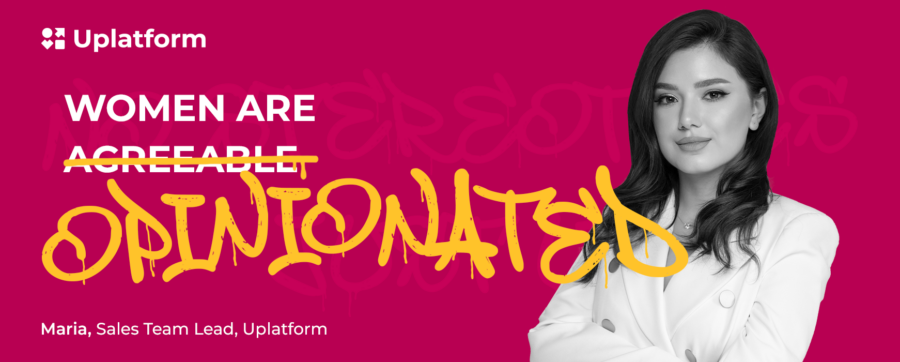
“Women are agreeable” – Maria, Sales Team Lead, Uplatform

Women are often expected to be agreeable, supportive, and accommodating in professional settings. While collaboration is important, leadership also requires the confidence to question ideas, express clear positions, and challenge decisions when they don’t align with the goals of the team or the business. Maria tackles this expectation directly:
“Being opinionated doesn’t mean being confrontational; it means being prepared, clear, and respectful. I challenge when something doesn’t align with our goals or values.”
She also addresses the narrative that women need “help” to succeed:
“I separate emotion from execution. Disagreements are resolved by looking at data, priorities, and business impact. When discussions stay focused on results, disagreements become productive.”
“Women can’t handle pressure” – Maria Vartanians, Senior Sales Manager, 18Peaches

High-pressure roles are often seen as environments where only certain personalities can succeed. Sales targets, negotiations, and leadership decisions demand resilience, sharp judgment, and the ability to stay steady when outcomes are uncertain. Yet women in these roles are sometimes assumed to be less suited to that pressure. In reality, many build their careers precisely by navigating complexity, expectations, and responsibility across multiple fronts. For them, pressure isn’t an obstacle. It becomes the ground where resilience, clarity, and leadership are formed. Maria Vartanians puts it simply: women don’t just handle pressure, they build under it.
“In senior leadership, visibility isn’t neutral; it’s amplified. And for women, it usually comes with commentary. Success is still defined differently for women and men. For men, it’s usually measured by career progress only. For women, it’s expected to include career, marriage, family, and social approval all at the same time. That’s why the idea that women can’t handle pressure has always sounded cliché. Women don’t discover pressure at work; we arrive there already trained.
Most women carry pressure across multiple fronts: delivery at work, a second shift at home, children, household responsibilities, and the mental load of keeping everything running. Add the pressure of simply being a woman in society, where confidence is judged, standards are constant, and you’re expected to look calm while carrying weight. So the issue isn’t capacity. The reality is women carry more, more often, and are still expected to make it look effortless.”
Maria continues:
“In my career, sales is the purest form of pressure: targets, negotiations, client expectations, and the need to be sharp, communicative, friendly, and persuasive every day. And once the contract is signed, the pressure doesn’t end; it upgrades. It becomes ownership, accountability, and results with your name on them.
Leadership also comes with scrutiny. Your decisions are challenged more, your mistakes last longer, and your successes are explained faster. That can drain you unless you operationalise it. I treat constant evaluation as information: anchor everything to measurable outcomes, communicate early so interpretation has less space to grow, document impact, set boundaries, and work with people who value execution over perception. But when scrutiny becomes predictable, it stops being pressure and becomes feedback. And feedback, used properly, builds resilience, and over time, that resilience turns directly into performance. ”
Her final word? Women don’t just handle pressure—they build under it.
“Women get promoted for diversity” – Marie Reyjal, Head of Sales, Sigma Group

In roles where success is measured through revenue, growth, and delivered targets, career progression is usually expected to follow clear results. Yet when women reach senior positions, their promotion is sometimes attributed to diversity efforts rather than the work and outcomes behind it. In reality, leadership in these roles is built on consistent results and measurable impact. Marie reframes it with a simple metric: performance.
“I’ve always worked in roles where performance is measurable: revenue, growth, targets achieved. I know the results I’ve delivered. But stepping into leadership, I’ve noticed that some people assumed my promotion was linked to diversity rather than performance. No one says it directly, but you feel that you have to prove yourself a little more. You’re not just leading, you’re validating that you earned your seat at the table. That creates extra pressure. Because instead of simply focusing on driving results, you’re also managing perception.
I think the way forward is transparency and consistency. When promotions are clearly tied to measurable impact, and that impact is visible, assumptions lose power. And the more women we see successfully leading revenue roles, the less this question will even come up.”
“Women want only family” – Maria Bashkevich, Head of Marketing, Uplatform
Questions about family plans still appear in conversations about women’s careers more often than they should. Sometimes directly, sometimes between the lines, they suggest that personal life and professional ambition must eventually compete with each other. In reality, every career path is shaped by individual choices, not assumptions about what someone might want in the future. As if professional drive somehow disappears the moment personal life enters the picture. Maria knows this narrative all too well — and she’s not buying it.

“At 30, during interviews, I was repeatedly asked if I was married or planning to have children. Apparently, that mattered more than my portfolio or my ability to grow a brand and increase ROMI.”
The questions weren’t just awkward; they reflected a deeper assumption about what women’s career paths are supposed to look like.
“A recruiter friend later told me one company chose a ‘safer’ candidate — a man — assuming I might go on maternity leave soon. His offer, by the way, was 45% higher than what we had discussed. Assumptions are expensive  Five years later, that assumption still looks ironic. Interestingly, none of my male peers was ever asked similar questions.
The issue isn’t family. The issue is the assumption that career paths can be predicted based on gender. That motherhood is automatically my priority. If I choose it, it will inevitably compromise my ambition or performance. And underlying all of this is another assumption: that parenting is primarily a woman’s responsibility.”
Family is a personal decision. Performance is professional. They are not the same conversation.
What I want is a choice, the freedom to be whatever I want and have whatever I want, without assumptions, questions, or judgment.”
Maria’s story is a reminder that ambition doesn’t come with a template, and it certainly doesn’t need permission. Success looks different for everyone, and the strongest careers are the ones shaped by choice, not expectation.
“Women are weak” – Lucie Kadlecová, CMO, Aviatrix

Strength is often imagined as something loud, aggressive, or purely physical. In reality, leadership strength looks different: it shows up in difficult decisions, clear boundaries, responsibility, and the willingness to take risks. Let’s start with a classic stereotype that women are “weak.” Lucie Kadlecová would probably laugh at that idea if she weren’t busy proving the exact opposite. Having started her career in iGaming more than a decade ago, Lucie remembers a very different industry.
“Having started my career in the iGaming industry 10 years ago, I worked my first years as a Marketing Manager in a completely different environment than you can see now. It used to be a male-dominated industry back then, and women in iGaming were mostly just the sexy hostesses, and rarely had a managerial position.
Mostly during events, it led to quite a few situations when I was viewed as ‘good-looking supporting staff’ and not as someone who is a company representative.”
Instead of letting those assumptions define her, Lucie relied on persistence, professionalism, and a steady belief in her expertise.
“It took a lot of resilience and consistency to prove my qualities as a marketing professional and have people realise that I am not just a pretty face. Step by step, alongside how the iGaming industry has been changing, I became a respected professional in this industry. Today it feels almost unreal that it used to be like that.
“I’ve always been professional, hardworking, and a leader who is both strong and empathetic and supportive to their team. I’m also a risk-taker and a strong decision maker, and I’m always ready to take full responsibility for my decisions.”
This industry is not for the weak. It is extremely dynamic and demanding. I think that having this long track record of 10 years in the industry, and still being alive and sane (most of the time, haha), I have proved to myself and everyone else that I am strong enough.”
Lucie’s story is proof that strength doesn’t always arrive with noise or spectacle. Sometimes it’s persistence, confidence, and the quiet determination to show up, deliver results, and let your work speak louder than stereotypes.
“Women are lucky to succeed” – Kristina Topal, Senior Sales Manager, 18Peaches

When someone succeeds quickly, people sometimes explain it as luck. It’s an easy way to understand results without looking at everything that happened behind them. Women in business often hear this more than men, especially in industries where leadership and sales have traditionally been male-dominated. Kristina Topal knows this one all too well.
“People sometimes say women in iGaming are ‘lucky’ to get where we are. Honestly, I’ve heard it more times than I can count. But success comes from curiosity, persistence, and showing up consistently—not luck. Every deal, every project, every launch is built on learning, hard work, and trusting your own judgment.
And yes, beauty is often seen as an advantage… but sometimes it actually makes things harder. People don’t always take women seriously. In a male-oriented industry, when you’re dealing with guys, some assume you’re only skin-deep. Some treat you like a pretty doll, not someone who can challenge them, solve real problems, or say something nobody has said before. Sometimes conversations shift into something more personal, and the truth is: being a successful woman isn’t an easy milestone to reach.
The bigger point is that women deserve recognition for skill, capability, and results. And… I won’t lie, looking cute and keeping a big smile is a bonus too!”
Kristina adds that assumptions about readiness for high-stakes decisions are equally common:
“Show up, do the work, lead with confidence—and yes, do it with a smile. Because in the end, results speak louder than assumptions. The more we show up and deliver, the harder we are to underestimate.  ”
”
“Women belong in support roles” – Dina, Head of B2B Projects, Uplatform

For a long time, many industries quietly placed women in coordination or support positions, roles that kept things running but rarely carried visible authority. The assumption was simple: organisation and assistance suited women better than decision-making or strategic leadership. Over time, that narrow view has steadily faded as more women have taken on roles that shape projects, teams, and business outcomes. Dina’s experience reflects that shift and challenges the idea that careers should follow a predetermined path. As she puts it:
“Any situation of success is almost always accompanied by assumptions from others about how it was achieved and why the circumstances unfolded the way they did. This is natural. People want to understand and sometimes repeat someone else’s path. But every development story is unique. Many factors influence the result: the decisions that were made, timing, circumstances, the people around you, and, of course, a certain amount of luck.”
For Dina, the real focus isn’t copying someone else’s formula; it’s recognising opportunities and making the most of them.
“What matters much more is the ability to recognise your own opportunities, understand your goals, and make use of the chances that appear. At the same time, it’s important to remember that any achieved result is only one stage — after which the next stage can always begin.”
Her approach to work reflects that mindset: curiosity, adaptability, and a genuine love for tackling challenges.
“What probably helps me the most is flexibility and the ability to navigate changing circumstances quickly. I really enjoy learning and constantly look for new opportunities to develop and improve what I do. Difficult tasks don’t scare me; on the contrary, they create a healthy sense of excitement to find the optimal solution and do something genuinely interesting and new.
“Women are ‘too much’” – Josmar Diaz, Regional manager Iberoamerica, Endorphina

Leadership often requires directness, clear opinions, and the confidence to challenge existing ideas. Yet when women demonstrate those qualities, they can sometimes be labelled as “too much,” while the same behaviour is often interpreted as decisiveness or strong leadership in men. Josmar Diaz has encountered this dynamic throughout her career in male-dominated industries.
“Yes, definitely. I’ve experienced this many times as a woman working in male-dominated environments, especially in fields like commercials and now in igaming. There is often an unspoken expectation that women should be agreeable, always smiling, and not challenge decisions too much. When you express a strong opinion or push for a different approach, it can sometimes be perceived as being ‘too much,’ while the same behaviour from men is often seen as leadership.”
For Josmar, the real issue lies in the double standard around assertiveness, particularly in creative and strategic roles where strong ideas and clear direction are essential. Women in these positions can find themselves balancing decisiveness with the expectation of being constantly likeable, something their male peers are rarely asked to manage.
“One of the main challenges is the double standard around assertiveness. In creative or strategic roles, strong ideas, clear direction, and confidence are essential, but when women demonstrate these qualities, they can be labelled as difficult or emotional instead of decisive or visionary. This can make women feel like they have to constantly balance being assertive with being “likeable.”
To move toward a more objective evaluation of leadership, the industry needs to focus more on outcomes, collaboration, and the quality of ideas rather than personality stereotypes. Encouraging diverse leadership styles and creating spaces where different perspectives are respected would help a lot. Leadership shouldn’t be measured by how closely someone fits a traditional mould, but by how effectively they guide teams, communicate ideas, and deliver results.”
At the same time, she has also encountered another common assumption: that women are less familiar with the gaming or technical side of the industry. In reality, she sees more and more women shaping strategy, products, and decisions across the sector.
“Sometimes there’s an expectation that women will focus more on communication or support roles rather than strategy, product, or decision-making. In reality, many women bring strong strategic thinking, creativity, and leadership to the table, and the industry benefits when those contributions are recognised and valued.”
Thread between stories
Across these stories, a pattern quickly becomes clear: stereotypes may try to define the starting point, but they rarely define the outcome. In fact, for many of the women who shared their experiences, these labels become something else entirely motivation.
“Weak” turns into resilience. “Family priorities” becomes a personal choice, not a prediction. “Support roles” expand into leadership, strategy, innovation, or whatever role someone decides to pursue.
Each story reminds us that stereotypes only work if they remain unquestioned. And the moment real experiences enter the conversation, those assumptions start to fall apart. What replaces them is something far more interesting: individual paths shaped by ambition, curiosity, persistence, and sometimes a bit of stubborn determination.
The bigger lesson? Skill, determination, and consistency will always outshine assumptions. And a little humour along the way definitely helps.
If these voices resonated with you, there’s more to explore. Uplatform has collected additional stories, reflections, and perspectives from women across our industry. Anyone can share their experiences and stories on Uplatform’s webpage and read others’ perspectives to discover even more voices shaping the conversation. The more openly we talk about it, the harder it becomes for anyone to ignore.
Conclusion
This International Women’s Month, let’s celebrate women who refuse to fit into outdated boxes. Let’s acknowledge their accomplishments, honour their choices, and challenge the labels that linger in workplaces worldwide.
Because here’s the truth: no stereotype can define these women—because they define themselves.
More Information & Source
Original Source:
Visit Original Website
Read Full News:
Click Here to Read More
Have questions or feedback?
Contact Us