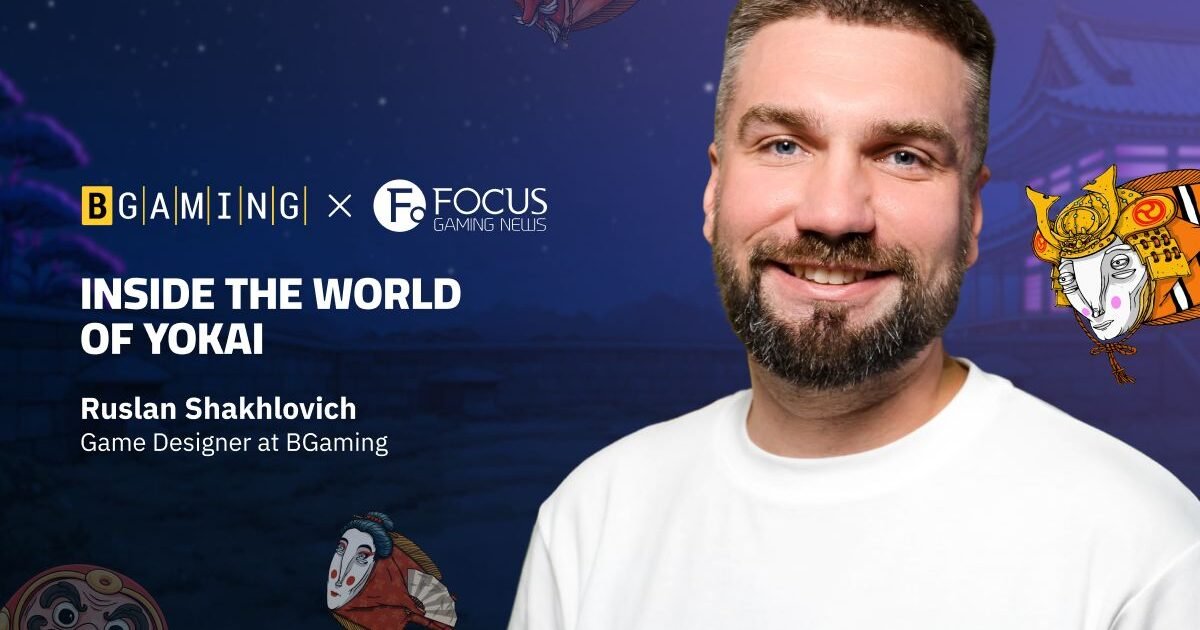
Focus Gaming News spoke to Ruslan Shakhlovich, Game Designer at BGaming, about Yokai, a new slot game based entirely on the artwork of the Portuguese street artist Gonçalo MAR.
Exclusive interview.- BGaming’s recent release Yokai turns the traditional game development process on its head, building an entire slot around the distinctive art of Portuguese street artist Gonçalo MAR. In this interview with Focus Gaming News, Ruslan Shakhlovich, game designer at BGaming, explains how this creative partnership shaped the game and laid the foundation for the new ART Collab series.
Most slot games begin with a theme or a mechanic. Yokai began with an artist. How did that reversal change the way the game was developed?
At BGaming, we usually start with a game concept or a mechanic and then build the visual world around it. Yokai was the opposite. We started with Gonçalo MAR’s art and asked ourselves: what kind of game could truly bring this style to life?
That completely changed the creative process. Instead of fitting the artwork into an existing idea, we built the whole experience around it. The characters, symbols, animations, and even some gameplay details were shaped by the mood and energy of Gonçalo’s work.
It felt much more collaborative and exploratory than a typical release. We spent more time experimenting, testing different ideas, and making sure the game stayed true to the artist’s vision while still feeling like a fun, engaging BGaming slot. I think that approach gave Yokai a personality that would have been hard to achieve if the art had come last.
What inspired BGaming to launch the ART Collab series, and why was Gonçalo MAR the right artist to begin it with?
The idea emerged a few years ago when our team collaborated with Gonçalo MAR on an exhibition in Lisbon as part of our marketing project, “When Art Meets Gaming.” His work immediately caught our attention, especially his signature finger-fish characters. They have a highly distinctive look, but what fascinated us even more was the sense of life behind them. They felt as though they already belonged to a living, breathing world beyond the canvas.
That sparked a conversation inside the team. Instead of asking which artist could decorate one of our games, we asked whether an artist’s work could become the starting point for creating one. That was a very different approach for BGaming.
Gonçalo was the obvious first collaborator because his work started that conversation. ART Collab wasn’t built around the idea of working with a famous artist. It grew from a genuine interest in his creative world and a desire to see how it could evolve into an interactive experience without losing its original character.
How closely was Gonçalo involved in shaping Yokai, and what did the creative exchange between the artist and the development team look like?
Gonçalo joined the project before development even began. We spent a lot of time talking about what works in a game and what makes his art recognisable. It wasn’t about handing over a brief and waiting for the final illustrations. It was an ongoing conversation from the very beginning.
We introduced him to the language of game design — why symbols need to be readable, how the interface works, what pop-ups and buttons are for, and the practical limits we have to work within. At the same time, he helped us understand which details of his style couldn’t be compromised and why they mattered.
Almost every major visual decision was discussed together. Sometimes we adjusted the game to fit the art, and sometimes we looked for ways to adapt the art without losing its character. That back-and-forth became a big part of the process.
As a result, development took around nine months, roughly 30–50 per cent longer than a typical BGaming release. But that extra time came from learning each other’s craft, not from trying to solve production problems.
Can you point to any features or interactions in Yokai that would not exist without Gonçalo’s artwork?
Yes, there are several elements in Yokai that came directly from Gonçalo’s artwork. His characters didn’t just become symbols on the reels, they influenced how the game moves and feels.
For example, after we introduced his signature characters, we created an animated transition between the base game and the bonus round where they fly across the screen. We also added a small Easter egg: when players tap the main character, his head changes into different finger-fish variations.
Another example is the Samurai character. His design naturally led us to create the Bonus Game entrance animation, where he cuts the moon with his katana to open the way.
These details came from the artwork itself. We didn’t have a finished game, and then added Gonçalo’s style on top. The visuals gave us new ideas and helped shape some of the game’s interactions.
Street art is designed to command attention at scale, while a slot has to remain clear on a mobile screen. Where did those two formats clash, and how did you resolve it?
The biggest challenge was that street art and slot games have very different ways of communicating. A large-scale artwork can rely on small details that people discover over time, while a mobile game has to be understood in a few seconds on a much smaller screen.
Some of Gonçalo’s original ideas were too detailed or too complex to work as game symbols. We had to rethink compositions, simplify certain elements, and adjust the level of detail while keeping the parts that made his style recognisable.
We also had to be selective with animations. Some transformations and close-up scenes looked great as standalone ideas, but they didn’t fit naturally into the rhythm of a slot game, where players move quickly between spins.
The goal was not to make the artwork simpler, but to find the version of it that worked best in a different format — one where every element has to be clear, functional, and still feel like Gonçalo’s work.
Yokai brings together Japanese folklore, contemporary European street art and slot mechanics. How did you turn these different influences into one coherent world?
Finding the right setting actually took quite a while. Once we had Gonçalo’s artwork, we looked for a world where his style would feel natural rather than added on afterwards. That’s how we arrived at Yokai. Japanese folklore is full of unusual spirits and creatures, and we felt it offered a lot of visual possibilities that haven’t been explored much in slot games.
Once we chose that direction, we realised one main character wasn’t enough to make the world feel alive. So we added small yokai that appear and disappear around the reels. They don’t affect the gameplay directly, but they create the feeling that something is always happening beyond the symbols themselves.
The Samurai became another important piece. He isn’t just part of the artwork, he plays a role in key moments of the game, including the transition into the Bonus Game.
What makes it all work together is that we never tried to recreate traditional Japanese art. We used Japanese folklore as the setting, while Gonçalo’s contemporary visual language gave it a fresh interpretation. The result feels like its own world rather than a mix of separate influences.
Beyond a distinctive visual identity, what did Yokai teach BGaming about building meaningful collaborations between artists and game developers?
Yokai helped us define how we want to approach collaborations between artists and game developers. During the project, we developed the creative foundation for the ART Collab series and learnt how to work with artists who have never created for games before.
One of the biggest lessons was to involve the artist from the very beginning. The best ideas came through regular conversations, where both sides influenced the final result.
ART Collab is also a way for BGaming to introduce contemporary artists to a new audience and explore games as a creative medium. Yokai was the first step, and we’ll keep developing the series based on what we learnt from this collaboration and how players respond to it.
More Information & Source
Original Source:
Visit Original Website
Read Full News:
Click Here to Read More
Have questions or feedback?
Contact Us

Other Articles