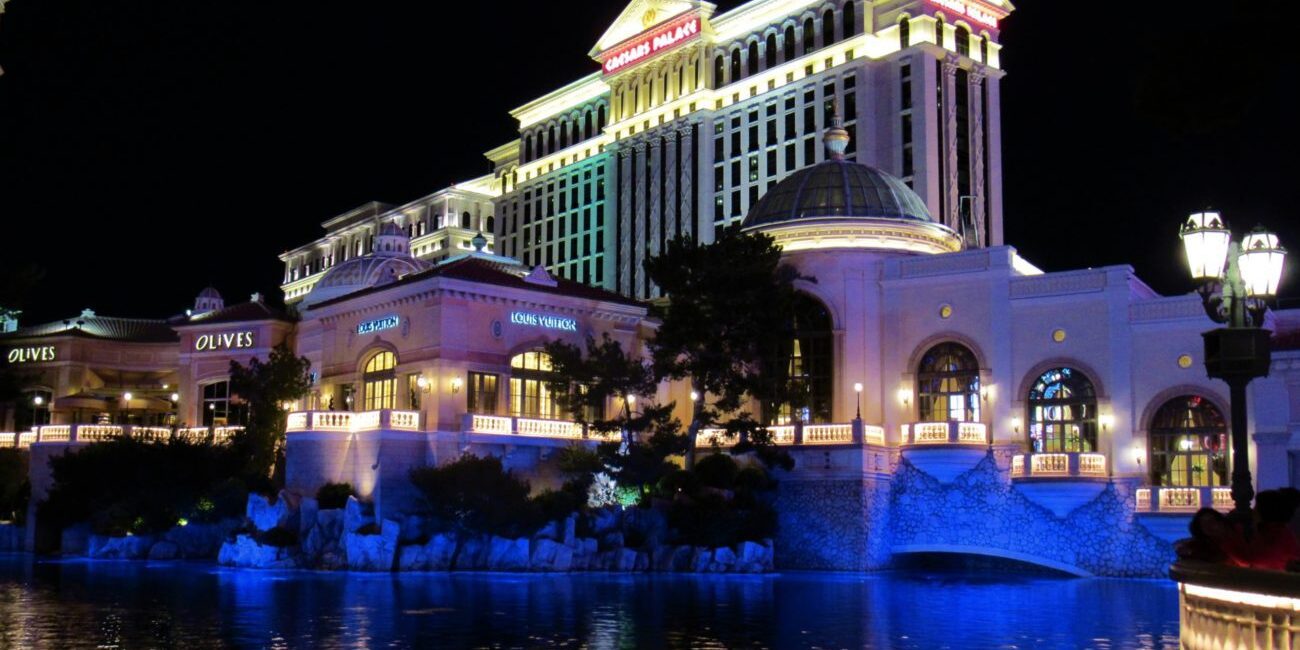
With the complaint against Caesars, each of the ‘big three’ operators in Las Vegas have faced AML fines this year.
The infamy of convicted illegal bookmaker Mathew Bowyer continues to spread throughout Las Vegas, as the Nevada Gaming Control Board announced late on Thursday that Caesars Entertainment had agreed to a $7.8 million fine for anti-money laundering failures in connection to the incarcerated bookie.
Caesars is the third Las Vegas gaming company to face fines related to Bowyer, joining MGM Resorts and Resorts World Las Vegas. Caesars’ shortcomings were detailed in a five-count, 21-page complaint also filed on Thursday but dated 10 November.
Bowyer, 50, reported to federal prison to serve a one-year sentence in October. Considered to be one of the biggest bookies in the US at his peak, Bowyer is most well-known for taking more than $325 million worth of action from baseball star Shohei Ohtani’s former interpreter, Ippei Mizuhara.
The Nevada Gaming Commission will consider the matter at its next meeting on 20 November. All of the AML fines administered this year have been accepted by the commission. If approved, Caesars’ $7.8 million fine would rank third among those levied this year. Resorts World paid $10.5 million and MGM’s total was $8.5 million.
“The board’s investigation revealed that Caesars and/or its subsidiary properties, including Caesars Palace, had identified, as early as April 2017 and on multiple subsequent occasions until he was banned by Caesars, suspicions regarding Bowyer’s activities, including that there was a lack of information regarding his source of funds and/or that his source of funds failed to justify his level of play,” the complaint reads in part.
What’s included in the Caesars complaint?
The five counts listed against Caesars in the complaint are:
- Failure to establish Bowyer’s source of funds
- Failure to ban Bowyer
- Failure to conduct adequate due diligence on Bowyer after receiving negative information
- Failure to elevate Bowyer to Caesars’ AML officer
- Failure to conduct an investigation
Caesars released the following statement:
“At Caesars Entertainment, integrity and regulatory compliance are paramount. We fully cooperated with the Nevada Gaming Control Board throughout its investigation and are committed to maintaining strong anti-money laundering and ‘know your customer’ programmes. We take our compliance responsibilities seriously and are dedicated to continuously strengthening our practices to meet and exceed the highest standards.”
Investigators said the misconduct by the operator ran from “sometime prior to 2017 until 22 January 2024”, when Bowyer was banned by Caesars. Bowyer was allegedly categorised as a “high risk” patron continually from June 2019 until he was banned nearly five years later. Caesars had documentation that “two other Las Vegas casinos had banned Bowyer” from May 2017.
The decision to ban the bookmaker came after news reports surfaced about his home being raided by federal authorities, the complaint says.
Overall, Bowyer was said to have “won and lost millions of dollars” at Caesars properties, including Caesars Palace, Harrah’s Resort Southern California and Harveys Lake Tahoe (now Caesars Republic Lake Tahoe).
Flurry of AML scandals for Nevada regulators
Often dubbed as the “gold standard” of US gaming regulation, Nevada has been besieged by AML scandals this year. In addition to the three Bowyer-related cases, Wynn Las Vegas was also fined $5.5 million in a separate AML-related case, and word of an additional investigation involving the Fontainebleau leaked earlier this year.
Regulators have expressed displeasure about the spread of these cases. NGCB member George Assad has been particularly vocal about the misconduct and Nevada Gaming Commission member Brian Krolicki has said the large fines should serve as a “clarion call” for the Las Vegas Strip. Nevada has two regulatory bodies: the NGCB handles day-to-day regulation and the NGC has final say.
Former Gaming Arts CEO Mike Dreitzer took over as NGCB chair in June, becoming the fifth chair since January 2019. Regarding repeated AML fines, Dreitzer told iGB at the Global Gaming Expo in October that the board “will have no problem” ratcheting up enforcement efforts if there is “recidivism” in the misconduct.
“Fines make headlines, but at the end of the day from my perspective it’s even more important that the operators, the licensees are acting in a corrective way, and that we are regulating and verifying that as we go along. … Certainly we are not afraid to continue to ramp up enforcement, if that means fines, whatever makes sense,” Dreitzer said.
The misconduct by Caesars is similar to the complaints against MGM and Resorts World. In all three cases, internal AML procedures were ignored and Bowyer was allowed to frequent the casinos freely for years despite the known risks.
Largely a year to forget for Caesars
For Caesars, the fine is the latest headache in what has been a tough year for the operator. Performance has been ho-hum in all three quarters this year, and Las Vegas profits in particular tanked in Q3.
Its digital segment has been the biggest bright spot, although analysts are largely expecting a spin-off or sale as it outpaces its retail operations. As competitors like FanDuel and DraftKings move ahead with prediction market deals, Caesars feels constrained by regulatory warnings from the NGCB. The board has made it clear that offering prediction markets could put Nevada licences at risk. As such, the company is stuck in limbo.
“As we’ve said before, we can’t be out in the lead on this one,” Caesars Digital president Eric Hession told analysts in October. “We’re going to monitor it, make sure we’re not left behind if there’s regulatory clarity. … Our best approach at this point is to monitor it, put our plans in place, make sure we’re adequately resourced and be ready to move if there’s a legalisation or definition in either direction.”
The company was also charging hard this year for a New York casino in Times Square. Theatre unions rallied to oppose the bid, however, and it was rejected by a local community board in September after more than 12 hours of public hearings.
Caesars’ share price dipped below $20 in trading Friday, and the stock is now down 41% year-to-date and 50% over the last 12 months. The company reported $11.9 billion in debt in Q3, markedly above its chief competitors Wynn ($10.5 billion) and MGM ($6.1 billion).
More Information & Source
Original Source:
Visit Original Website
Read Full News:
Click Here to Read More
Have questions or feedback?
Contact Us

Other Articles