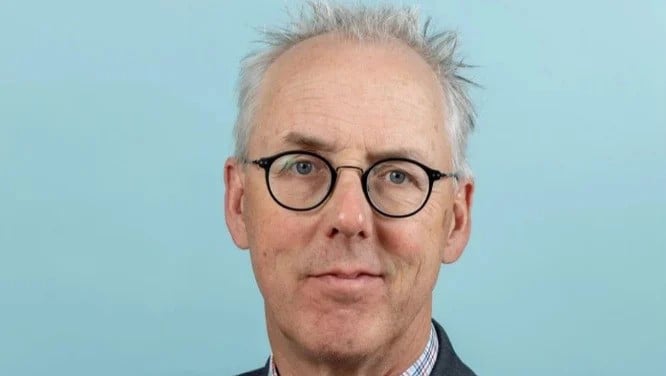
Michel Groothuizen of the KSA says a cross-border network like Interpol is needed to exchange information about illegal gambling.
Canada.- Michel Groothuizen, chairman of the Dutch gambling regulator Kansspelautoriteit (KSA), has proposed that global regulators establish a “Gambling Interpol”. He says an international organisation is needed to coordinate global enforcement action against increasingly sophisticated unlicensed gambling operations.
Speaking at the IAGR 2025 Conference in Toronto, Groothuizen said cooperation among global gambling regulators had been “not very fruitful“ so far despite a growing recognition of the futility of domestic-level action. But he said the exchange of information about illegal parties could be an enormous help for enforcement action.
”Let us put our efforts mainly into a sort of gambling Interpol; first Europe-wide, but then perhaps worldwide, he proposed. “I won’t pretend to have all the answers, because this is a growing and constantly evolving problem that sometimes feels like a Hydra: when we cut off one head, two new ones grow to take its place. We must therefore engage with parties who enable the growth of the illegal market.”
He said such an approach would need connections with big tech and big finance in order to ensure channels to get social media content removed and payment pathways blocked. Groothuizen had painted a stark picture of the expansion of illegal online gambling to justify his argument.
“Illegal gambling operators are infiltrating forgotten Dutch domains with high SEO scores to reach Dutch players,“ he said. “The domain names of bankrupt restaurants, coaches’ websites and even primary and secondary schools are being bought up to set up SEO pages about illegal gambling.
”Influencers are being used to log onto illegal casinos and promote gambling in livestreams, with thousands of euros being spent in some cases. Vulnerable young people are being sucked into the illegal circuit left, right and centre.”
“We failed on a very important point“
Groothuizen spoke candidly about where he believed Dutch gambling legislation had failed with the opening of the online gaming market in the Netherlands in October 2021.
”In the context of one of the main reasons for opening up the market, tackling illegal providers, we failed on a very important point,” Groothuizen said earlier in his speech. “In order to protect the freedom of the internet, the foreseen power to take down illegal websites included in earlier drafts was scrapped. While I absolutely understand that from the perspective of the open internet and countering government censorship, that amendment in the bill still causes us major problems.
”I realise from colleagues who have more powers that even this is not a silver bullet. Nevertheless, we try to tackle illegal websites in a myriad of ways, but the fact that we cannot immediately render them unavailable to Dutch players puts us at an automatic disadvantage in the battle with a very innovative and agile opponent.”
The KSA’s chair also lamented the initial political decision to apply “very open standards” for online gambling advertising inn the Netherlands.
He said: ”In a market with so much potential and so much money involved, you can bet that parties will push the limits of what is permissible. We warned the government about a tsunami of advertising, and were proved, regrettably, absolutely right. From October 2021 onwards, there was no escaping advertising by gambling companies. It was everywhere, from bus shelters to commercial breaks on television. And of course online. Pretty our soon politicians regretted their belief in open standards.”
Advertising ban not the answer
Since then, Dutch lawmakers have tightened the rules. First, a role model ban came into force, and then a ban on untargeted advertising in 2023 and a ban on sports sponsorship this year. But now things are in danger of swinging to the other extreme, Groothuizen warned.
”Our Dutch politicians are increasingly calling for [a complete advertising ban]. Still, I do not believe in such a total ban, especially as I look at the recent development of the market. Although our player channelisation rate has remained over 90 per cent, during the first half of 2025 we saw GGR-based channelisation fall slightly below 50 per cent for the first time.
”This means that roughly half the money involved in gambling in the Netherlands goes to illegal operators. It is the illegal market that benefits from the stricter measures we impose on the legal market. This doesn’t only have to do with advertising, but also with the stricter measures we have taken in terms of player protection.”
The KSA chair also stressed the need for healthy competition to ensure an attractive regulated market as the regulator prepares for the renewal of the five-year online gambling licences that began back in 2021.
He said: “I am curious to know which parties will decide to stay and invest further in the Dutch market, and which parties may abandon it. A healthy licensed market hinges on a sufficiently diverse and attractive offering of gambling websites. However, this does not mean that I intend to keep everyone on board at all costs.
“When we recently published our new policy rules for the second round of licensing, we as the KSA very actively expressed that we would be taking supervisory antecedents into account in the assessment. Those who have not conducted themselves in line with the standards we like to see as a regulator over the past five years will have to have a good explanation as to why that happened and especially how they will prevent that from happening in the future.
More Information & Source
Original Source:
Visit Original Website
Read Full News:
Click Here to Read More
Have questions or feedback?
Contact Us

Other Articles

10 Biggest Sports Betting Scandals That Shocked the World
KSA to Launch Limited Licenses for Skill-Based Machines