
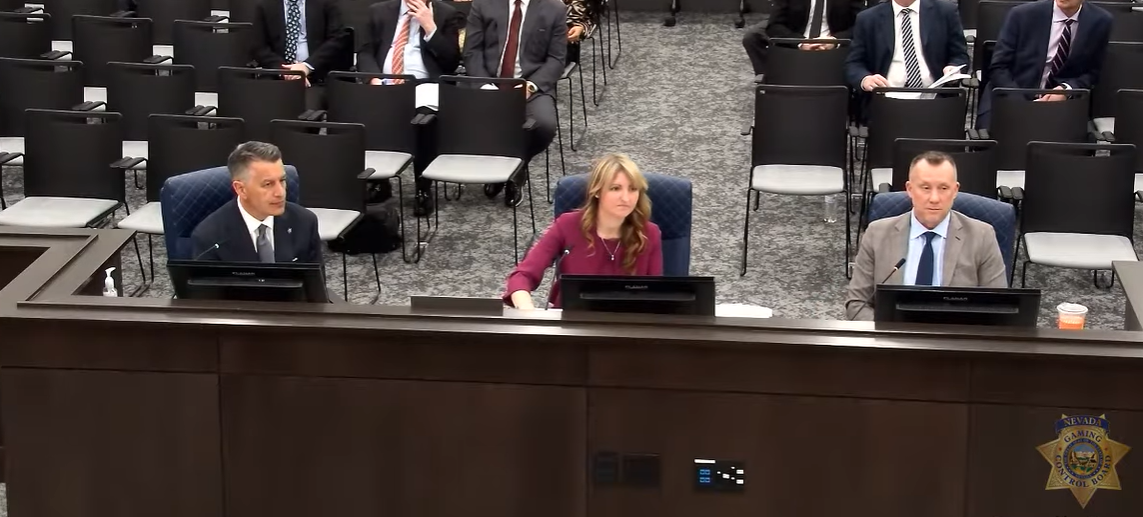
Sandoval and Burnett are two hugely influential figures in Nevada gaming, both past and present.
The Nevada Gaming Commission unanimously approved Brian Sandoval and AG Burnett for licensure on Resorts World Las Vegas’ board of directors Thursday, representing a rare moment across the dais for two men with decades of experience overseeing Nevada’s gaming industry.
Sandoval, who chairs the Resorts World board, previously served two terms as governor of Nevada and chaired the gaming commission, while Burnett helmed the Nevada Gaming Control Board for more than five years. Sandoval appointed Burnett to that role more than 10 years ago, and the two are teaming again to overhaul a Strip casino struggling to overcome financial and regulatory missteps.
The extensive connections between various parties required multiple disclosures and gave the hearing a somewhat jocular feel Thursday. In addition to Burnett, Sandoval also appointed Commissioner Abbi Silver to the Nevada Court of Appeals during his governorship, and Commissioner Brian Krolicki served as Sandoval’s lieutenant governor for four years, though the two were elected independently.
Krolicki said he’s spent “thousands of hours” with Sandoval in work settings over the years, and this familiarity inspired trust.
“I’ve also had a chance to see you behind the closed door, when it’s not public, and you have never been unwavering to what is right,” Krolicki said of Sandoval. “Never once have I seen you waver from doing what’s absolutely right for Nevada and the responsibilities you’ve had in your various positions.”
Resorts World last year received a $10.5 million fine for anti-money laundering violations, the largest AML penalty ever issued in Nevada. The creation of a casino-level board was stipulated in the fine, and Sandoval becomes the third Nevada governor to receive a state gaming licence, joining Paul Laxalt and Bob Miller.
Can Resorts World be saved from financial distress?
Meanwhile, the financial struggles for Resorts World will be a huge challenge to overcome. The casino opened in June 2021, and its $4.3 billion cost is still the highest ever for a Las Vegas property. Since then, it has been beset by both the AML scandal and the macroeconomic headwinds affecting Las Vegas overall.
Parent company Genting Berhad did not disclose the casino’s financials in its fourth-quarter earnings report. Instead, the company made several allusions to “lower visitation as well as macroeconomic uncertainty” for the market, and cited declines in tourism statistics. Looking ahead, Genting also emphasised a “robust calendar of conventions and Las Vegas city-wide events”.
On an earnings call with analysts, Genting CEO Kong Han Tan called Las Vegas’ underperformance “a blip” on the path to success.
“Genting Berhad has funded the deficits that Resorts World is facing,” Tan said. “We continue to stand behind the project. We always regarded Nevada to be a core asset and core center. We have learned a lot from being in Nevada, and that knowledge can easily be replicated. Our other properties are in a much better state of governance and compliance than ever before. I don’t see that as a waste.”
Sands controversy fused Sandoval, Burnett relationship
While there were few questions for Sandoval, Burnett faced a question from Silver that rehashed a controversial saga in Nevada’s gaming history and an important moment in Burnett’s and Sandoval’s relationship.
In 2016, then-attorney general Adam Laxalt met with Burnett, who was serving as NGCB chair, to ask the board to submit an amicus brief in a contentious wrongful termination lawsuit involving Las Vegas Sands and its founder, Sheldon Adelson.
“There was a lot of pressure placed on Mr. Laxalt to have the Gaming Control Board file an amicus, and he indeed asked us to file that amicus, and I said no,” Burnett told the commission.
Burnett declined several times to file the brief, and he went a step further by secretly recording his conversation with Laxalt. That recording crescendoed into a massive scandal that resulted in subpoenas and ethics investigations, and Sands was ultimately forced to settle the termination lawsuit and pay a $2 million fine in Nevada.
Sandoval was serving as governor while the controversy played out, and Burnett suggested that the ordeal made their relationship stronger.
“I was extremely proud about that situation and how it was handled,” Burnett said. “I was also fortunate to have a guy who was a former federal judge, a former attorney general and a great individual, the governor of the state of Nevada, who I could keep informed on the matter. He did not interfere in the matter, but I was fortunate to have his backing and support to do the right thing.”
Sandoval busy with UNR, GSR arena development
The task of turning around Resorts World’s fortune is a tall one, and both Burnett and Sandoval have full schedules as it is.
Sandoval is the president of the University of Nevada, Reno, and Burnett is a partner at McDonald Carano, one of the state’s most influential law firms. Between the control board and commission hearings, both men faced skepticism over whether the added work will interfere with their current responsibilities. Both said it will not be a problem.
Sandoval’s duties with UNR are in Reno, but he travels to Las Vegas “often” for board duties, he said last month. Prior to joining Resorts World, the former governor also struck a massive deal with Reno’s Grand Sierra Resort, which is embarking on a $1 billion expansion project centred around a new arena.
That arena will be used primarily for UNR men’s basketball, but the university is not committing any funds toward its development. Sandoval formed a relationship with GSR owner Alex Meruelo during his governorship, and UNR basketball, the most popular sports team in the region, is a key cog in the casino’s growth plans.
GSR Chief Marketing Officer Chris Abraham told iGB last year that “the university [was] the first group of people, after we had the idea, that we went to,” adding that it was “extremely important for us to engage with them” on the arena project.
Burnett defending state against prediction markets
Burnett, for his part, is still an immensely important figure for Nevada gaming despite leaving public service. He is among the McDonald Carano lawyers representing the Nevada Resort Association in the state’s lawsuits against Kalshi and Crypto.com. The association was approved as an intervenor in the cases. Both are being heard by the Ninth Circuit Court of Appeals.
Prediction market lawsuits have exploded in federal and state courts around the US, and Nevada is a key battleground. As the biggest gaming state in the country, it has substantial turf to defend against event contracts, and legal rulings so far have been split.
The NGCB was the first state regulator to issue a cease-and-desist order to Kalshi in 2025, and the exchange sued in response and won a preliminary injunction. That injunction was later dissolved, and both sides have since traded a series of filings as Kalshi scrambles to avoid litigation that Nevada is feverishly pursuing. Crypto.com has had less success in its suit, as its request for an injunction was denied by the same judge who dissolved Kalshi’s.
As among the counselors advocating for the state’s position, Burnett is on the front lines against what could be considered the biggest threat ever to Nevada’s industry.
“These wagers are the same as the sports bets offered by state licensed sportsbooks and do not qualify as ‘swaps’ under the Commodity Exchange Act,” an NRA filing from last week reads. “Kalshi cannot credibly argue that whether a football team performs a specific type of trick play or scores a two-point conversion is ‘associated with a potential’ real-world ‘financial, economic, or commercial consequence,” as required to qualify as a ‘swap’.”
Jess Marquez
Jess has covered the global gaming industry since 2022. A native of Reno, Nevada, he’d like to note that it’s Ne-va-da, not Ne-VAH-da.
More Information & Source
Original Source:
Visit Original Website
Read Full News:
Click Here to Read More
Have questions or feedback?
Contact Us

No Comment! Be the first one.