
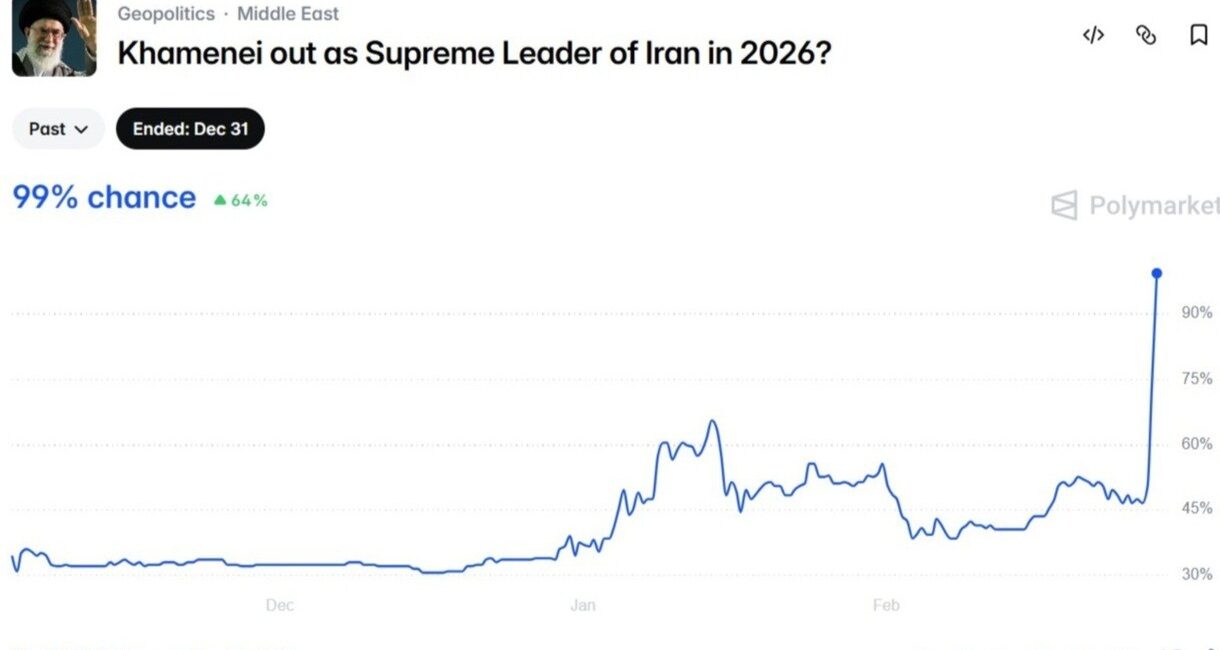
Calls for stiffer regulations on prediction markets are growing louder after controversy over trades on Khamenei’s ouster.
Hours after the US military’s stealth attack on Iran, Kalshi CEO Tarek Mansour moved swiftly to clarify the company’s position regarding event contracts on the invasion.
As protests intensified throughout Tehran in January, Kalshi listed a contract on whether Ali Khamenei would be ousted as supreme leader of the nation. Then, last weekend, amid conflicting reports on the death of the longtime leader, traders became skittish on the clearing process for the multimillion-dollar contract market.
On 28 February, the US and Israel launched massive airstrikes against Iran, two days after a convoy of air and naval ships appeared in the region. Around 1:37 pm ET that day, US President Donald Trump announced the death of Khamenei, predating an announcement by Iranian state media. Iran, which maintains a ban on sports wagering, confirmed Khamenei’s death on 1 March, at 5:00 am local time.
Within a period of 15 hours, the odds on Khamenei’s ouster spiked from 27% on the evening of the 27 February to 61% at 9:00 am ET on the morning of 28 February. But later that evening, following Trump’s announcement, Kalshi CEO Tarek Mansour delivered a curveball.
Citing a Kalshi rule that enables the exchange to temporarily suspend a market at the discretion of the company, Kalshi paused activity on the market.
Before the suspension, trading volume on the contract reached $54.5 million, a sliver of activity compared to Polymarket, which surpassed $529 million on a similar derivative. As several traders opened their positions hours earlier, the markets sparked fresh concerns on the potential for dissemination of material non-public information across the new asset class. One prominent US senator, who already had plans for crafting anti-prediction market legislation, vows to eradicate the market from trades directly tied to death.
Death carveouts
The Iran-related trades represent the latest wrinkle in the jurisdictional turf war on the regulation of prediction markets. Last month, US Commodity Futures Trading Commission Chair Michael Selig announced that the federal derivatives regulator filed an amicus brief on behalf of Crypto.com in a case before the Ninth Circuit of Appeals.
The announcement came on the heels of Selig’s appearance at a joint harmonisation event with the SEC in which the chair provided the agency’s strongest backing yet on the legal permissibility of sports-event contracts. Since then, Mansour received a spot on the CFTC’s Innovation Advisory Council, alongside other top industry executives such as DraftKings’ Jason Robins, Polymarket’s Shayne Coplan and Crypto.com’s Kris Marszalek.
In a response on Mansour’s X page that garnered 3.7 million views, the Kalshi CEO explained the site’s decision for listing the markets without a death carveout. For one, CFTC Rule 40.11 prohibits event contracts on subjects associated with war, terrorism and assassination, among others. Mansour took it one step further, arguing that Kalshi opts to list contracts without a death carveout because traditional markets, most notably oil futures, can be a proxy for war and death.
“We believe that’s different than having a market directly settling on someone’s death, which is not allowed for US regulated entities,” Mansour wrote.
Kalshi reimbursed all fees from the market. For traders who held a position before Khamenei’s death, Kalshi paid out users on the last-traded price before his passing. For traders who held a position after his death, Kalshi decided to fully reimburse their cost of entry. Kalshi, for its part, announced the suspensions of two users last week for insider trading in cases unrelated to Iran.
Win some, lose some
Polymarket, one of Kalshi’s main rivals, also listed a bevy of contracts on Khamenei’s demise. In total, six accounts on Polymarket delivered combined profits of approximately $1.2 million on the trade. One trader under the name “Magamyman”, appeared to make a profit of $515,000. The user, according to Polymarket data, placed the trade a mere 71 minutes before news of the initial strike broke.
Others also saw their trades pay off handsomely. Despite placing several unsuccessful trades earlier in the week, a user returned a six-figure profit. The trader known only as “Planktonbets”, hit the jackpot with $173,907 in net profits. Separately, another anonymous user, “Neodbs”, turned a $9,884 investment into $89,000, achieving a whopping return of around 900%.
Not all trades, however, were successful. In the run-up to the invasion, a trader built up a $2 million position by wagering against the escalation. Suddenly, though, his fortunes turned south when a series of “No” wagers on a US invasion by a certain date left him exposed to a major loss. The trader, “Anoin123”, apparently lost more than $6.4 million in a single day.
Prediction markets on Iran raise concern
Days before the attacks, Connecticut Senator Chris Murphy excoriated the Trump administration for allowing contracts on the length of the annual State of the Union address.
Murphy, a three-term senator, claimed that the derivatives are susceptible to manipulation since the address is typically reviewed first by members of the administration. The trades on Khamenei spurred Murphy to move forward with a bill that may establish federal standards on prediction markets. Another lawmaker, Arizona Senator Ruben Gallego, took exception with the lack of safeguards on insider trading.
This is “insider trading in broad daylight, this should be illegal,” he wrote on social media.
The Iran-linked contracts also served as a hot topic at this week’s Seton Hall Law School Gaming Bootcamp in New Jersey. Adrian King, partner at Ballard Spahr, criticised the CFTC’s Selig for not implementing robust standards to enforce alleged insider trading. While trades placed on the blockchain provide traders with the specter of anonymity, Andy Booth, managing director at EY, indicated that prediction markets have the surveillance capabilities to identify users in notable events involving anomalous trading movement.
As of Thursday afternoon, Kalshi and Polymarket each had more than a dozen markets on the Iran conflict. A Kalshi market on the next Supreme Leader of Iran has already seen trading volume surpass $7.75 million. Polymarket, meanwhile, pulled a market on Tuesday on whether a nuclear war will break out this year. The market garnered more than $1 million in trades.
Khamenei, 86, spent nearly 40 years as supreme leader of Iran. While he ruled last summer that predicting sports outcomes for prizes is not inherently forbidden in Iran, the nation’s judicial branch continues to treat gambling as an offence, punishable by lashing and imprisonment.

Matt Rybaltowski
Matt is primarily responsible for long-form feature coverage on complex sports betting scandals. He also provides coverage on finance, M&A and other technological developments.
More Information & Source
Original Source:
Visit Original Website
Read Full News:
Click Here to Read More
Have questions or feedback?
Contact Us

No Comment! Be the first one.