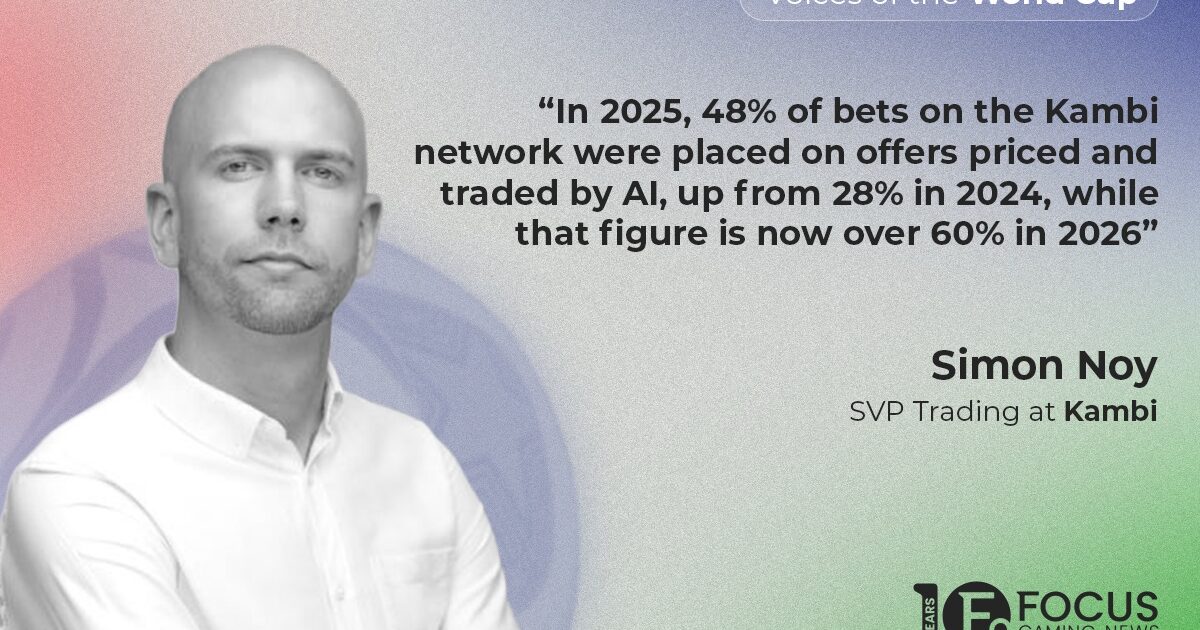
In the second instalment of “Voices of the World Cup”, Focus Gaming News spoke with Simon Noy, SVP Trading at Kambi, about the evolution of sports betting pricing and the impact of AI-driven trading.
Exclusive interview.- As the sports betting industry prepares for the expanded World Cup 2026, technology, automation and artificial intelligence are reshaping how sportsbooks price, manage and personalise betting experiences at scale. With 104 matches, 48 national teams and an unprecedented volume of betting opportunities, operators face new challenges in delivering accurate odds, managing risk and engaging customers throughout the tournament.
In this exclusive Focus Gaming News interview, the second in the “Voices of the World Cup” series, Simon Noy, SVP Trading at Kambi, reflects on the evolution of sportsbook trading from manual operations to AI-powered models that price and manage millions of betting combinations in real time. He discusses the growing role of automation and why the World Cup 2026 could become a defining moment for the next generation of sports betting technology. Noy also shares insights into the challenges and opportunities created by the tournament’s expanded format, and explains how operators can leverage AI-driven trading to strengthen customer acquisition, retention and long-term profitability.
When you started in the industry, what did pricing look like for a high-volume event, a Champions League final, or a World Cup?
I began my career in the sports betting industry in 2008, and the evolution which has occurred in pricing and trading during peak moments in the sporting calendar has been nothing short of remarkable.
The scale of the offering has expanded exponentially, growing from match winner and anytime goalscorer markets to one which can support thousands of interrelated combinations, while the growth of live betting and introduction of features such as cash out have revolutionised the relationship between bettor and bookmaker. The result is that these major events offer a bigger opportunity to appeal to a wider range of bettors than ever before. With the World Cup 2026 on the horizon, it is Kambi’s role to empower our partners to capitalise.
Traders have dominated sportsbooks for decades – at what point did Kambi conclude that traditional trading was no longer fit for purpose?
It wouldn’t be accurate to frame traditional trading as no longer fit for purpose, and instead I would say that this is simply part of the ongoing evolution in our technological capabilities – and one which also enables human expertise to be deployed where it can be most impactful. The expansion of Kambi’s AI-driven trading represents a natural and considered shift from second-generation trading to third-generation trading – that is to say, moving from machine-assisted human trading to human-assisted machine trading. In 2025, 48 per cent of bets on the Kambi network were placed on offers priced and traded by AI, up from 28 per cent in 2024, while that figure is now over 60 per cent in 2026.
The importance of AI trading is emphasised by the fact that bettors’ preferences are moving towards more complex bet offers, including those with multiple interrelated legs and stat-led player props driven by granular data – offers human trading has a huge challenge to price and manage effectively.
Furthermore, advancements in data and trading are removing the limitations on what can be effectively priced, risk-managed and settled. The early indication of this evolution is underlined in the development of the Bet Builder – whereas the first bet builders could combine two to three offers, such as 1X2 and over/unders, now Kambi’s can profitably and sustainably cater to hundreds of thousands of interconnected combinations. AI trading and automated modelling are increasingly required as we seek to capitalise on the removal of these limitations in offering creation and deliver the right bet to the right customer at the right time.
“In 2025, 48 per cent of bets on the Kambi network were placed on offers priced and traded by AI, up from 28 per cent in 2024, while that figure is now over 60 per cent in 2026.”
Simon Noy, SVP Trading at Kambi.
What decisions is AI-trading making autonomously during a live match?
If we focus on soccer, AI is fundamental to every aspect of delivering the live offering – setting the initial odds, and reacting in the space of milliseconds to the ingestion of new game state data and betting activity to ensure the odds are as accurate as possible.
A key area where AI trading is delivering tangible live uplift for Kambi partners is in the smarter application of market availability and suspension logic. Traditionally, when there was any uncertainty – such as an unclear event on the pitch – markets were suspended entirely to protect against risk. This protects margin in the moment, but negatively impacts the user experience and therefore the prospect of long-term retention.
Harnessing AI, decisions on suspensions and delays can be made at a much more granular level. Instead of suspending an entire market, operators can adjust only the specific aspects affected by uncertainty. This keeps more markets open for longer, maintaining player engagement without compromising trading integrity.
The World Cup 2026 involves 104 matches, 48 national sides, and real-time micro-markets across multiple time zones simultaneously. Is there anything about this tournament that presents a genuinely new challenge for Kambi, something that wasn’t on the table in Qatar 2022?
The impact of the expanded format is a key factor at play for any sportsbook targeting success from the World Cup. 48 teams, ten more days of competition and a new knockout round of 32 all translate into more betting moments, matchdays and a richness of opportunity to acquire, engage and retain customers.
While the ultimate aim for Kambi is the same as it is at any sporting event – to deliver a deep and best-in-class offering – this expanded format does offer several fresh opportunities and considerations. More teams joining the competition has the potential to throw up a number of one-sided fixtures. These games, where the 1X2 holds less appeal, with Germany against Curacao being an example, place the focus on having a really strong player prop offering – it is here that Kambi partners will benefit from an expanded selection of markets on assists, shots, fouls and even player vs. player markets.
The additional knockout round also means more chances for games to go the distance, bringing extra time and penalties into play. Sportsbooks must settle enormous volumes of pre-match and in-play bets from normal time, while simultaneously managing a surge in new betting activity during extra time and shootouts.
Highlighting this, Kambi’s penalty product generated 17 per cent of total bets on Portugal-France at Euro 2024, despite the shoot-out accounting for 8 per cent of total match time. Kambi’s offering enables customers to bet on not only whether a penalty will be scored, but also how it might be missed, be that saved, hitting the woodwork or flying past the frame of the goal entirely.
Will human traders become irrelevant, or do they evolve into AI supervisors during mega-events like the World Cup? How has the profile of a trading professional changed inside Kambi since AI became central to your operation?
Humans will never be irrelevant when it comes to trading, and as an organisation of more than 1,000 with a singular focus on sports and sports betting, Kambi prides itself on having a depth of human expertise which no other B2B sportsbook supplier can match.
One thing that AI and automation do unlock is the ability to deploy human expertise and decision-making where it can be most effective. Ideation and the crafting of new products and bet types which harness the growing wealth of sports data at our disposal are just one aspect of this. And throughout an event such as the World Cup – which presents the most significant opportunity for the sports betting industry in years – marrying the quality of our technology with the experience and know-how of our teams gives Kambi’s partners the best opportunity to succeed on the biggest stage.
“Humans will never be irrelevant when it comes to trading.”
Simon Noy, SVP Trading at Kambi.
There are still operators out there running hybrid or largely manual trading models. How wide is the efficiency gap becoming, and how long do you think they have before it becomes genuinely difficult to compete?
The gap between sportsbooks like Kambi and the capabilities of those sportsbooks which are still reliant on second-generation, manual trading will continue to widen over the coming years.
One of the main differentiators is the scale of the data sportsbooks are able to draw from. Kambi processes billions of bets each year, and across a network of around 70 partners, has a global liquidity pool that exceeds US$17bn.
Automation in trading requires huge amounts of data to successfully train the algorithms and develop the models required to not only price an increasingly vast offering, but also to effectively risk manage and settle this expanding offer in a manner that delivers strong, sustainable margins and protects the bottom line. The UX is another factor here – as the scale of the offering grows, not overwhelming the interface and delivering an on-demand experience which presents the right bet to the right user at the right time is a development imperative.
Operators that do not have access to this extent of historic bet data face a natural disadvantage in unlocking the full potential of AI trading and attempting to keep pace with how sportsbooks and the trading function are set to evolve over the next three years.
What do you think will be the single development during the World Cup 2026 that the industry will look back on as a genuine turning point?
I would love to say an England win, but fretting over Harry Kane’s fitness means we’re best off staying in the realm of sports betting technology for this question. As highlighted above, I think this will be a defining tournament for customer acquisition and retention, and one where the potential of AI trading as a differentiator and enabler of best-in-class betting experiences will be keenly felt. Marketing and CRM are crucial facilitators, but it is strength in the core product and a quality and depth across all sports that will enable operators to not only acquire customers throughout the tournament, but also retain them long after the final whistle has been blown.
This is the second instalment of Voices of the World Cup, an exclusive interview series exploring how the sports betting and igaming industry is preparing for the FIFA World Cup 2026™. Over the coming weeks, Focus Gaming News will speak with the most influential leaders in the sector on AI-driven trading, platform stability, Bet Builder innovation, next-gen retention and crypto integration.
Follow the series at focusgn.com
More Information & Source
Original Source:
Visit Original Website
Read Full News:
Click Here to Read More
Have questions or feedback?
Contact Us